

HCM City has proposed a series of technical and policy solutions to the Ministry Agriculture and Environment to strengthen the implementation of Việt Nam’s methane-reduction action plan through 2030.
The proposals were included in Report No. 286/BC-UBND on the city’s 2025 results in implementing the Prime Minister’s Decision No. 942/QĐ-TTg approving the national methane-emission reduction plan.
According to the report, the city has proactively taken steps in crop cultivation, livestock farming, solid-waste management and wastewater treatment — all major sources of methane emissions.
Communication programmes have been carried out to raise awareness among officials, businesses, farmers and communities about the benefits of methane reduction, promoting greener consumption and production and more responsible waste recycling and reuse.
Waste collection and treatment remain the city’s largest source of methane emissions.
In wastewater management, the city’s flood-control and treatment projects have adopted several measures to cut methane emissions.
Adjustments to the action plan will be made in 2026 to ensure consistency in management and further reduce emissions across waste, wastewater, crop production and livestock sectors.
The city is also strengthening cooperation with international partners, including working with JICA on technical support for developing model, smart and eco-oriented industrial parks.
It is supporting household solid-waste treatment projects using modern, energy-recovery technologies.
In agriculture, the city continues shifting low-yield rice cultivation areas to higher-value annual and perennial crops, aligning with its approved crop-structure transformation plan.
Local agencies regularly monitor emerging pests and provide climate-based recommendations on crop protection.
Significant achievements
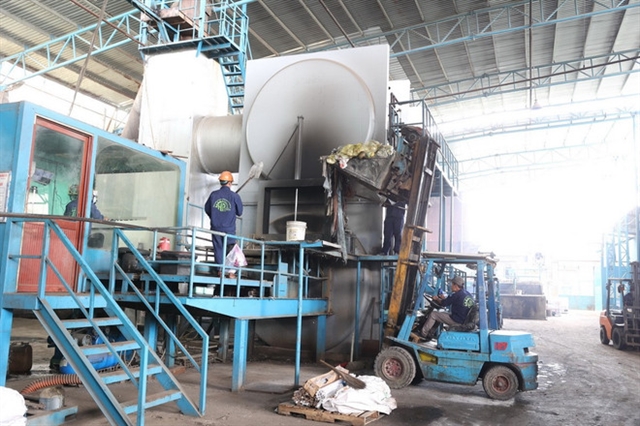
This year, the city put into operation three new transfer stations and accelerated technology upgrades at household waste treatment plants.
Five investors have registered to convert to waste-to-energy technologies with a combined capacity of 8,500 tonnes per day, with two projects already licensed and under construction.
A pre-feasibility study for a 2,000-tonne-per-day waste-to-energy plant under the PPP model is also underway, expected to be operational by 2028.
In wastewater treatment, Bình Hưng, Tham Lương-Bến Cát and Bình Hưng Hòa plants continue to operate using aerobic biological technology, contributing to methane reduction.
The Nhiêu Lộc-Thị Nghè plant is completing a system to capture methane from sludge, set to become a model for emission reduction.
In farming, the city has expanded “One must, five reductions” and “Three reductions, three gains” models, and converted 142ha of low-efficiency rice land.
More than 70 training sessions and multiple demonstration models have helped farmers adopt low-emission production practices.
Livestock farming has also advanced through climate-adaptive duck models, probiotics, and improved feed management for dairy cattle.
Over 500 enterprises joined environmental training sessions, while 100 businesses received guidance on energy transition.
Challenges and recommendations
Despite progress, the city reported several difficulties.
Administrative restructuring in some areas has slowed implementation, while biogas and feed additives for methane inhibition require substantial investment without sufficient preferential policies.
Methane capture from sludge remains technologically challenging, and several industrial facilities still lack adequate emission data, affecting communication planning and monitoring.
To address these issues, HCM City recommends that central ministries need to issue consolidated technical guidelines on methane reduction in crop production, livestock farming and wastewater treatment; improve capacity-building for officials in emission accounting and low-emission technologies; finalise financial mechanisms and incentives for new technologies, particularly waste-to-energy and sludge-treatment systems; and expand international cooperation and technology transfer for eco-industrial development.
In 2026, the city aims to update its methane-reduction plan in line with its new administrative boundaries, complete additional transfer stations, support waste-to-energy projects, strengthen wastewater treatment, expand crop-structure transformation and scale up low-emission livestock models.
Last month, a city delegation led by Party Secretary Trần Lưu Quang inspected progress at the Tây Bắc Solid Waste Treatment Complex, urging investors to ensure waste-to-energy projects are completed on schedule by 2026 and calling for planning adjustments to facilitate implementation.
(VNS)