

Việt Nam will need hundreds of billions of US dollars for green finance investment over the next five years, according to Chu Đức Lâm, deputy director general of the Department of Sectoral Finance and Economics under the Ministry of Finance.
He cited the revised National Power Development Plan VIII, which estimates capital requirements for the 2026–30 period at more than US$100 billion, most of it expected to come from the private sector and foreign investors.
He added that various international studies also point to substantial annual financing demand for green growth and the energy transition in the years ahead.
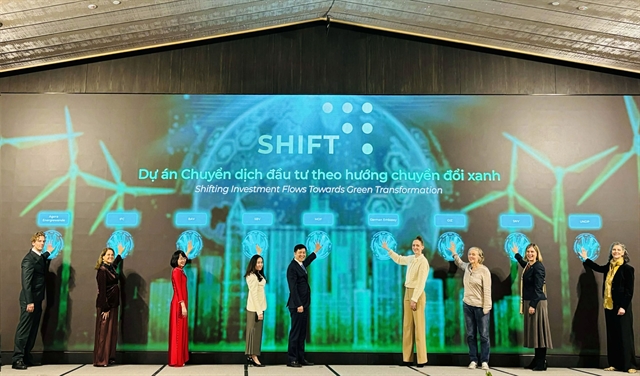
Against this backdrop, the Ministry of Finance and six international partners on Tuesday launched the Shifting Investment Flows Towards Green Transformation (SHIFT) project to help create favourable framework conditions for green investment, particularly in energy transition, while strengthening the capacity of key stakeholders.
Lâm said that mobilising such vast resources would require a coherent and consistent policy ecosystem, including capital mobilisation strategies, suitable incentive mechanisms and the development and effective operation of green financial instruments.
“The SHIFT project launched today carries particular significance. It will not only help foster a more enabling environment for green investment and finance as well as Việt Nam’s energy transition, but also serve as a platform for policy and technical cooperation, supporting Việt Nam’s gradual alignment with international practices and global standards on green finance, carbon markets and sustainable investment,” he said.
Under the project, enterprises investing in energy transition technologies will be linked with potential financiers.
Through facilitated platforms and open dialogues, stakeholders will be able to exchange ideas, build mutual understanding, raise concerns and discuss new policies and incentives.
SHIFT also supports businesses in testing, piloting, scaling up and replicating clean energy solutions, with particular attention to women-led enterprises and small and medium-sized companies, helping demonstrate the commercial and technical viability of relevant technologies.
The project forms part of Germany’s International Climate Initiative (IKI) and is commissioned by the German Federal Ministry for the Environment, Climate Action, Nature Conservation and Nuclear Safety (BMUKN).
Six organisations are implementing the project: Agora Energiewende, the Banking Academy of Việt Nam, the Deutsche Gesellschaft für Internationale Zusammenarbeit (GIZ) GmbH, the International Finance Corporation (IFC), the Netherlands Development Organisation (SNV) and the United Nations Development Programme (UNDP).
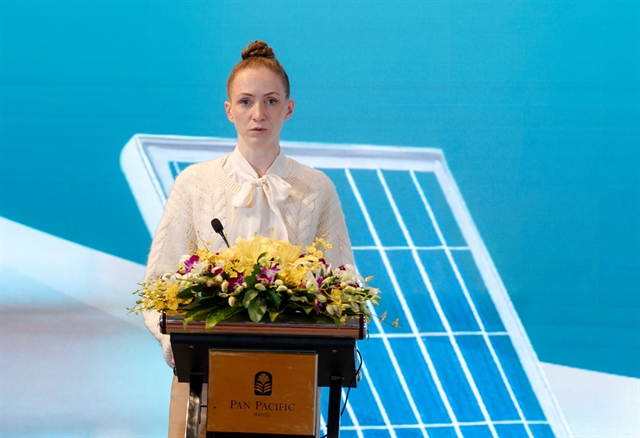
Alexandra Westwood, attaché for Economic Affairs and Development Cooperation at the German Embassy in Việt Nam, said green investment and green energy technology are at the heart of the project.
“SHIFT will support national authorities through capacity building in reform processes, work with financial institutions to expand green finance and assist enterprises of various sizes in deploying innovative green energy technologies,” she said.
She noted that advancing green finance and clean energy is a complex process requiring sound policy frameworks, financial expertise and technical capacity. By combining the strengths of all partners, SHIFT aims to foster meaningful collaboration and generate greater impact in supporting Việt Nam’s development and climate goals.
Việt Nam has pledged to achieve net-zero emissions by 2050, a target that will require profound economic transformation and massive investment, estimated at $2.4 trillion by that year.
According to the State Bank of Vietnam (SBV), a government partner in the SHIFT project, green credit in the country has continued to expand in both scale and pace.
As of December 31, 2025, outstanding green credit reached about VNĐ770 trillion, with an average annual growth rate of more than 20 per cent during 2017–25, higher than overall credit growth in the economy.
Phạm Thị Thanh Tùng, deputy director general of SBV’s Credit Department for Economic Sectors, said the trend reflects a positive shift from awareness to action within the banking system in supporting the transition towards a green and sustainable growth model.
(VNS)