

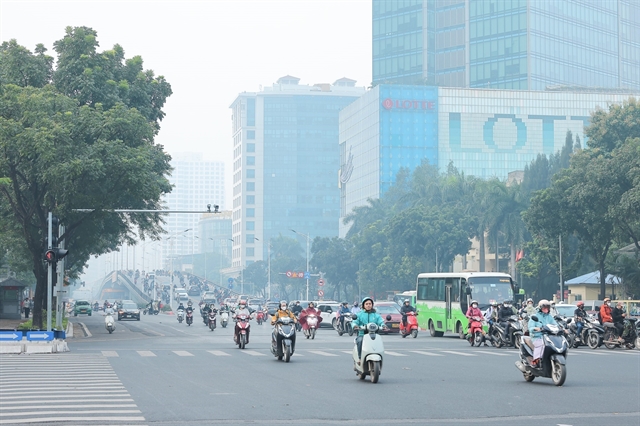
At rush hour in Việt Nam’s biggest cities, traffic inches forward as motorbikes and cars crowd the roads, engines idling in unison. The exhaust is no longer visibly thick, but it lingers all the same, settling into lungs rather than hanging in the air.
Behind these familiar scenes lies an escalating crisis. Transport emissions are rising just as Việt Nam has pledged to drive them to zero.
In Hà Nội, more than 9.2 million vehicles are currently on the roads. The city directly manages over 8 million of them, while nearly 1.2 million additional vehicles from other provinces regularly circulate through the capital.
The result is chronic congestion and mounting environmental damage.
Air pollution in Việt Nam follows a seasonal pattern, peaking at certain times of day and worsening during specific months. But in major urban centres such as Hà Nội and HCM City, those pollution cycles are becoming longer and more intense.
In early December 2025, Hà Nội’s air quality index (AQI) repeatedly reached very bad levels, even climbing to 223. Concentrations of fine particulate matter, known as PM2.5, exceeded safe thresholds on multiple days, posing direct risks to public health, especially for children, the elderly, and people with pre-existing conditions.
Authorities point to one dominant cause: the sheer volume of motor vehicles, many of them ageing models that no longer meet emissions or service-life standards.
Combined with prolonged traffic jams, the result is a steady build-up of exhaust gases and airborne particles that urban air systems struggle to absorb.
For residents, the impact is tangible.
Phạm Lan Hương, an office worker in Hà Nội, says commuting has become physically draining.
“Every morning, I feel short of breath. The roads are packed, and the sky feels white with dust,” she said.
After weeks of irritation and watery eyes, she visited a doctor and was diagnosed with rhinitis.
“I can’t say for certain that pollution caused it. But every time I go out these days, I feel my health being affected,” she said.
The idea of leaving the city altogether, she added, crosses her mind more often than she would like.
Việt Nam’s transport dilemma comes at a pivotal moment. At the UN climate summit in Glasgow, 2021 (COP26), Prime Minister Phạm Minh Chính pledged that the country would aim to achieve net-zero emissions by 2050, a commitment framed as a global responsibility and a strategic shift towards sustainable development.
Meeting that target will require sweeping changes across multiple sectors, from energy and finance to manufacturing and exports. But transport sits at the centre of the challenge.
For decades, the country focused its transport policy on reducing congestion and road fatalities. Net-zero has added a new and unavoidable requirement: decarbonisation.
Electric vehicles are becoming more visible on Việt Nam’s streets, but adoption remains limited.
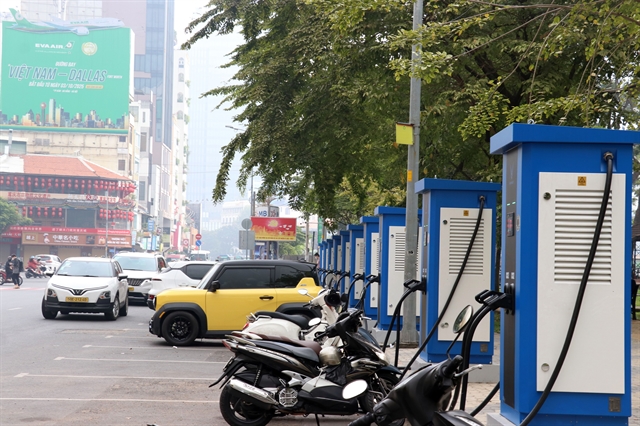
Charging infrastructure is sparse, upfront costs remain high, and public transport has yet to provide a credible alternative to private vehicles. Habits built over decades do not change quickly.
As a result, the green transition is proving to be less of a technological hurdle than a social one.
Đàm Hoàng Phúc, Director of the Automotive Engineering Programme at Hanoi University of Science and Technology, describes three core bottlenecks: infrastructure, cost and behavioural change.
Infrastructure, he argues, is the most immediate constraint.
“Green vehicles require a matching ecosystem, charging stations, parking facilities and unified technical standards,” he said.
Việt Nam currently lacks all three at scale. Charging networks remain fragmented, regulatory frameworks incomplete, and urban planning often unprepared for widespread electrification.
This uncertainty deters consumers and investors, turning charging stations from supporting infrastructure into a risky new service sector.
Cost is the second barrier. Electric vehicles still carry higher price tags than petrol-powered models, placing them out of reach for many consumers and complicating investment decisions for manufacturers.
The third challenge, behaviour, is perhaps the most difficult to overcome. Vietnamese drivers are accustomed to vehicles that refuel quickly, are easy to repair, and rely on a dense network of petrol stations.
Electric vehicles demand new routines, longer planning horizons and trust in battery durability and long-term costs.
“What we need is a clear, stable policy framework,” Phúc said.
“One that gives manufacturers confidence to invest, shows consumers what infrastructure will look like and explains how costs will be supported during the transition.”
Policy, he added, must be grounded in scientific research and backed by public consensus.
Others point to an even bigger structural risk.
Khương Kim Tạo, a former senior official at the National Traffic Safety Committee, warns that Việt Nam’s electricity system itself could become a critical bottleneck.
“Many people assume that building charging stations and connecting them to the existing grid will be enough. But without careful planning, the power system could be overloaded or worse,” he said.
Without solutions to grid capacity and energy supply, he added, even the most ambitious vehicle electrification plans could stall in practice.
Taken together, these challenges suggest that Việt Nam’s shift to green transport will be a long, complex process requiring coordination across government, industry and society.
Infrastructure, cost and behavioural change form the pressure points that will determine whether the transition succeeds. This is not simply a question of technology or capital investment, but a test of social readiness for a fundamental transformation of urban mobility.
If policies become clearer and more stable, charging networks expand coherently, vehicle prices fall and public understanding improves, green transport may cease to feel like an imposed burden and begin to look like a natural choice.
As experts repeatedly stress, technology and funding are only the starting point. The decisive factor will be trust – trust in policy, in infrastructure and in the idea that cleaner mobility is achievable and worth the effort.
Only when individual road users begin to change their behaviour alongside national policy shifts can Việt Nam realistically accelerate towards lower emissions, cleaner air and a transport system fit for a rapidly urbanising future.
(VNS)