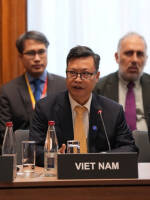

When executives at local automaker VinFast began presenting their environment, social, and governance (ESG) profile to international partners in 2024, the reaction was unexpectedly candid. At the recent ESG Vietnam Forum 2025, Mr. David Edgardo Falcon Adasme, Director of ESG at VinFast, recalled that some partners were surprised that a Vietnamese manufacturer had already embedded ESG so deeply into its strategy and operations. The response was not about branding or awards, but about credibility – whether Vietnamese companies were truly prepared to operate under the same sustainability expectations as their global peers.
That moment reflects a broader transition underway in Vietnam’s business landscape. ESG is no longer discussed primarily as a moral aspiration or a compliance checkbox. It is increasingly framed as a condition for participation – in supply chains, capital markets, and international partnerships.
ESG as competitiveness
For companies operating in globally-exposed industries, ESG is becoming inseparable from competitiveness. At VinFast, this has meant integrating ESG into its long-term strategy rather than treating it as a parallel initiative. According to Mr. Adasme, ESG has shifted from something companies “should do” to something they “must do” if they want to compete internationally. Trust – from investors, partners, and society – now hinges on whether ESG commitments can be demonstrated in practice.
VinFast’s net-zero roadmap is built around three pillars: electrification, energy efficiency, and green energy. These include expanding electric vehicle production and charging infrastructure, embedding energy-saving targets across departments, and investing in renewable energy such as rooftop solar power at its Hai Phong plant.
VinFast’s ESG approach does not stop at internal operations, as it has worked to standardize ESG requirements across its supply chain, aligning suppliers around shared sustainability benchmarks. According to Mr. Adasme, most of VinFast’s global value chain now operates under common ESG standards, reinforcing the idea that sustainability cannot be achieved in isolation.
Mr. Vo Dinh Trung, Deputy General Director of the Innovation and Sustainability Center at Duy Tan Plastics, part of the SCG Group, argued that ESG is fundamentally about process management rather than compliance. “The biggest challenge is not about knowing what ESG requires, it is knowing how to measure and optimize such practices across the entire supply chain,” he said.
For manufacturers, growth has traditionally meant the increased use of virgin materials and higher emissions. Introducing recycled plastics into production, Mr. Trung explained, offers a way to sustain growth while reducing environmental impact, but only works when data is reliable and processes are transparent.
SCG applies a framework known as “ESG 4 Plus,” which includes reducing net emissions, addressing inequality, and advancing circular economy models where the output of one process becomes the input of another. The philosophy reflects a shared reality across industries: no single company, or even a single sector, can achieve green growth alone.
From ambition to operations
While ESG is increasingly accepted as inevitable, measurement remains its hardest test. In the financial sector, Mr. Nguyen Hung, CEO of TPBank, addressed the tension many businesses face. ESG is often perceived as a costly investment, especially when standards are not yet fully mandatory and companies remain under pressure from cash flow, operating costs, and market volatility.
For banks, however, ESG is no longer a decision that can be delayed. Technology, Mr. Hung said, is essential to survival. A bank that does not invest in digital systems will struggle to compete, and ESG-related investments in data, transparency, and governance are part of that technological backbone.
At TPBank, digitalization has transformed operations. Monthly transaction volumes have grown from fewer than 1 million under traditional models to around 200 million today, with more than 98 per cent processed through digital channels. The cost difference is dramatic: a traditional transaction can cost up to 300-times more than a digital equivalent once labor and operational expenses are factored in.
ESG at TPBank is tracked at the level of individual processes. Each workflow is analyzed based on how many people are involved, how many manual steps are required, and how much time is consumed. If a machine can complete a task in one minute while a human needs ten, automation becomes the preferred option.
This approach has enabled the bank to quantify environmental impact more clearly. In its latest sustainability report, TPBank has disclosed its greenhouse gas emission intensity for the first time, reporting 0.87 tons of CO2e per VND1 billion ($38,460) in revenue, down from 1.16 tons the previous year. Energy, fuel, and paper consumption per unit of profit have also declined significantly.
Measurement also matters beyond individual enterprises. Mr. Nguyen Cong Minh Bao, Country Director of the Global Reporting Initiative (GRI) in Vietnam, emphasized that standardized reporting frameworks are becoming central to ESG credibility.
GRI standards are now used by some 77 per cent of the world’s 250 largest companies and adopted in 128 countries and territories. In Vietnam, approximately 96 companies currently apply GRI frameworks. For small and medium-sized enterprises, ESG pressure increasingly comes from international markets rather than domestic regulation.
Vietnam’s export-oriented economy means that suppliers embedded in global value chains must comply with requirements such as carbon border mechanisms and sustainability standards in the US and Europe. “If you cannot measure it, you cannot manage it,” Mr. Bao said, warning that weak measurement increases the risk of “greenwashing.”
Cost, culture, and limits
Ms. Nguyen Thi Hai Binh, CEO of the STP Group, described cost as the most immediate concern for many businesses. The real question, she continued, is not whether to pursue ESG, but how long the journey will be, how much it will cost, and what remains if the effort falls short.
After four years of implementation, the STP Group found that ESG spending is not a burden when approached pragmatically. Still, some of the most important ESG elements – corporate culture, ethics, and fairness – remain difficult to quantify, particularly in technology and manufacturing firms.
There is no comprehensive framework for measuring “ESG culture,” Ms. Binh noted. But waiting for perfect standards only delays progress. Companies can begin with concrete, measurable actions and refine their approach over time, supported by technology that enables tracking, monitoring, and transparency.
Manufacturers face additional internal challenges. Differences in ESG awareness between management, technical teams, and frontline workers make uniform implementation difficult. As a result, internal communication on the task must be tailored to different employee groups rather than applied uniformly.
External pressure adds another layer of complexity. Some shareholders remain skeptical, viewing ESG as vague, long term, and difficult to complete while companies juggle production and operational demands. This skepticism can turn ESG into a genuine strain on decision-making.
Despite these challenges, Ms. Binh emphasized persistence. ESG, she argued, should be framed as a meaningful journey rather than a burden, one that leaves lasting value even if not all targets are achieved immediately.
Across the discussion, a clear shift emerged: ESG is moving from early adoption to unavoidable expectation. Companies that once gained an advantage by acting first now face a different reality: readiness will determine who adapts smoothly as standards tighten.
As the experience of banking, manufacturing, and export-oriented industries shows, ESG is no longer just about compliance or reputation. It is becoming part of how Vietnamese businesses organize operations, manage risk, and position themselves in a global economy where sustainability is increasingly the price of entry.
Linh Tong