
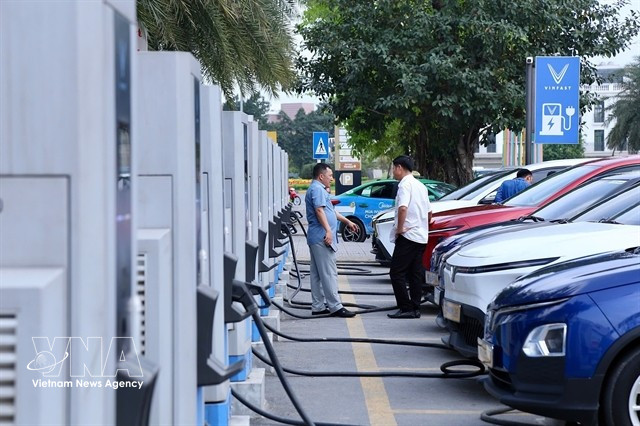
The Government’s decision to extend the zero percent registration fee for battery electric vehicles (BEVs) until December 31, 2030, under Decree No 202/2026/ND-CP is far more than a consumer incentive.
For foreign investors, it represents one of the clearest policy signals yet that Vietnam is committed to building a long-term electric vehicle ecosystem. More importantly, it provides the policy certainty that multinational automakers need when making investment decisions involving billions of dollars and planning horizons stretching over five to ten years.
For foreign direct investment (FDI) enterprises, the biggest obstacle in entering a new market is often not infrastructure or logistics, but the predictability of government policy.
Over the years, many global automotive brands have approached Vietnam’s EV market cautiously, concerned that incentives could be short-lived or subject to frequent revisions. Such uncertainty makes it difficult for multinational corporations to justify large-scale investments in manufacturing facilities, supply chains and distribution networks.
Decree 202/2026 effectively addresses that concern.
Issued on June 8, 2026, the decree extends the zero percent first-time registration fee for battery electric vehicles through the end of 2030. The policy will take effect from March 1, 2027, replacing Decree No 51/2025/ND-CP, which amended provisions of Decree No 10/2022/NĐ-CP on registration fees.
According to the Ministry of Finance, the global electric vehicle market has expanded rapidly in recent years and has become a key pillar of the automotive industry. Global EV sales surpassed 17 million units in 2024, accounting for more than 20% of total vehicle sales, and are expected to exceed 20 million units in 2025, representing over one-quarter of the global market.
At the same time, charging infrastructure has continued to expand, while governments worldwide are increasingly restricting fossil-fuel vehicles and encouraging the adoption of cleaner transportation alternatives.
Against this backdrop, registration fee incentives have emerged as one of the most widely used tools to lower the initial cost of EV ownership and accelerate market adoption.
The extension of Vietnam’s registration fee exemption is therefore more than a fiscal measure. It supports the country’s broader green transition strategy, promotes environmentally friendly transportation and contributes to reducing emissions.
Industry experts say the commitment to maintain the incentive through 2030 creates a stable investment environment, enabling foreign automakers to formulate medium- and long-term business strategies with greater confidence.
The policy also reinforces Vietnam’s commitment to achieving net-zero emissions by 2050, as pledged at COP26. Rather than a temporary demand-stimulation measure, it forms part of a broader policy framework aimed at reshaping the domestic automotive industry.
For foreign brands such as Toyota Motor Corporation, Hyundai Motor Company and Honda Motor Co Ltd, as well as emerging manufacturers from China and the Republic of Korea, the registration fee exemption helps narrow the price gap between electric and internal combustion engine vehicles at the point of purchase.
As upfront ownership costs become more competitive, automakers will have greater flexibility to introduce new EV models across multiple segments, from affordable urban vehicles to premium SUVs.
Vietnam’s appeal extends well beyond its population of more than 100 million people. Increasingly, it is being viewed as a potential EV manufacturing hub within ASEAN.
With policy support guaranteed through 2030, automakers are likely to move beyond a cautious market-testing approach and consider more substantial commitments to the country.
Strengthening competitiveness through localisation
The accelerating global transition to clean mobility, combined with growing competition from domestic brands, is likely to encourage foreign manufacturers to shift from importing fully built vehicles to assembling them locally.
Local production not only allows manufacturers to maximise the benefits of supportive policies but also helps reduce costs through more efficient sourcing of components and supply chain management, improving overall price competitiveness.
However, registration fee incentives alone will not be enough to attract high-quality EV investment over the long term.
Global manufacturers are paying increasing attention to energy infrastructure, charging standards and the integration of digital technologies into urban transport systems. While Decree 202/2026 sends a strong signal of policy commitment, investors will also want to see continued progress in the development of a nationwide charging network, standardised charging systems and a modern electricity grid capable of supporting widespread EV adoption.
These factors will ultimately determine whether policy advantages can be translated into lasting competitive strengths.
The localisation of EV manufacturing could also transform Vietnam’s supporting industries. When a major automaker establishes local production, it typically brings with it a network of suppliers producing batteries, power control systems, specialised plastics and precision metal components.
Such developments would create valuable opportunities for Vietnamese manufacturers to integrate more deeply into global value chains.
Without long-term policies such as Decree 202/2026, Vietnam risks remaining primarily a consumer market. With them, the country has an opportunity to position itself as an active participant in the global shift towards electric mobility and advanced manufacturing.
From the consumer perspective, the policy offers reassurance. Buyers can make purchasing decisions with greater confidence, knowing that incentives will remain in place for several more years.
As EV adoption increases, manufacturers will face growing pressure to accelerate investments in charging infrastructure and after-sales services. This creates a virtuous cycle: incentives stimulate demand, stronger demand encourages investment, and greater investment further supports market growth.
Competition beyond incentives
The outlook, however, is not without challenges.
The growing presence of competitively priced EV models from foreign manufacturers is likely to intensify pressure on conventional gasoline-powered vehicles, potentially accelerating shifts in market share.
Automakers operating in Vietnam will increasingly compete on technology rather than traditional engineering alone. Consumers will evaluate vehicles based on software capabilities, driving range, connectivity and integration with broader digital ecosystems.
As a result, foreign brands will need to localise their offerings more effectively, tailoring vehicle specifications, digital services and mobile applications to the preferences of Vietnamese consumers.
Viewed in a broader context, the extension of the registration fee exemption to 2030 represents a strategic move that places Vietnam firmly within the global race to become a centre for electric vehicle production and innovation.
The domestic market is approaching a pivotal moment, where success will be determined less by engine performance and mechanical durability and more by the speed of electrification and the ability to deliver technology-driven customer experiences.
For foreign investors, the message is clear: policy stability is no longer a question mark. Those that move early and invest decisively in Vietnam’s EV ecosystem are likely to secure significant advantages in the decade ahead./.
(VNA)