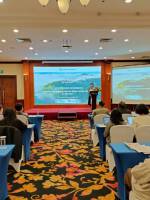


A conference in Hà Nội on Friday brought together researchers and policy specialists to examine how countries worldwide are reshaping their climate policies after COP26 and how Việt Nam can apply those lessons as it works towards net-zero emissions.
The event was organised by the Institute of Human Geography and Sustainable Development (IHGSD) in partnership with the National Foundation for Science and Technology Development. It forms part of a national-level research project analysing climate-policy reforms in several countries and drawing out implications for Việt Nam’s own transition.
According to participants, the post-COP26 period has marked a decisive shift from setting targets to implementing them.
Dr Nguyễn Song Tùng, head of IHGSD, said nations are now pursuing mid-century net-zero goals through wide-ranging reforms that extend far beyond the energy sector. Climate considerations are increasingly shaping policy in transport, industry, agriculture, finance and trade.
Countries have taken varied paths, with some introducing climate acts and carbon-pricing systems while others have expanded support for renewable energy, restructured fossil-fuel subsidies or launched technology programmes in carbon capture and storage.
Examples highlighted at the conference included Japan’s green-growth agenda, Indonesia’s balanced energy transition, the integrated circular and green-economy models in Singapore and Thailand and Europe’s well-established carbon-trading system.
Dr Tùng said learning from these experiences will help Việt Nam chart a realistic path for policy reform at home.
Deputy head of IHGSD, Dr Đỗ Tá Khánh, said the study, running from February 2025 to May 2027, aims to provide scientific backing for Việt Nam’s climate-policy decisions and its commitment to net-zero emissions. The conference was held as part of the research process, gathering additional international perspectives and expert input.
From 19 papers submitted, nine were presented, covering energy transition, emission-reduction policies, climate finance and carbon markets and emerging green-economy models. These discussions will help refine the project’s analytical framework and support upcoming recommendations to policymakers.
Speakers pointed in particular to Thailand as an instructive example.
Dr Phạm Thị Trầm and Dr Nguyễn Hồng Quang said Thailand has made its COP26 commitments tangible through simultaneous policy adjustments in energy, transport, agriculture and industry. The country has boosted incentives for low-emission technologies, expanded green financing, operationalised carbon taxes and markets and accelerated solar, wind, biofuel and electric-vehicle development.
They suggested Việt Nam accelerate legal reforms, introduce targeted support packages to reduce transition costs for businesses and use a mix of market tools and mandatory rules on emissions reporting and reduction. Expanding renewables, developing energy from agricultural by-products and investing in carbon capture, storage and utilisation were highlighted as key next steps.
Delegates also analysed policy shifts in Japan, Singapore, Indonesia and India. Japan’s GX-ETS, a carbon-pricing system designed to drive its green transformation agenda, stood out alongside the country’s climate-transition bonds and its mobilisation of roughly 150 trillion yen for emission-cutting projects. Indonesia’s Just Energy Transition Programme and Singapore’s push for mandatory carbon markets and strong incentives for clean technologies were similarly highlighted.
Experts at the conference recommended that Việt Nam adopt a long-term legal and policy framework with clear emissions targets, widen green-finance channels, build a domestic carbon market and scale up solar, wind and green-hydrogen development. They also underscored the importance of international cooperation to access technology, finance and modern climate-governance models, foundations seen as essential for Việt Nam to reach net zero by 2050.
(VNS)