
As Việt Nam steps up efforts to green its rice sector, experts have underlined the urgent need to officially recognise rice straw as a biomass resource, develop national technical standards and manage it under a circular economy approach to support low-emissions agriculture and the country’s net-zero target by 2050.
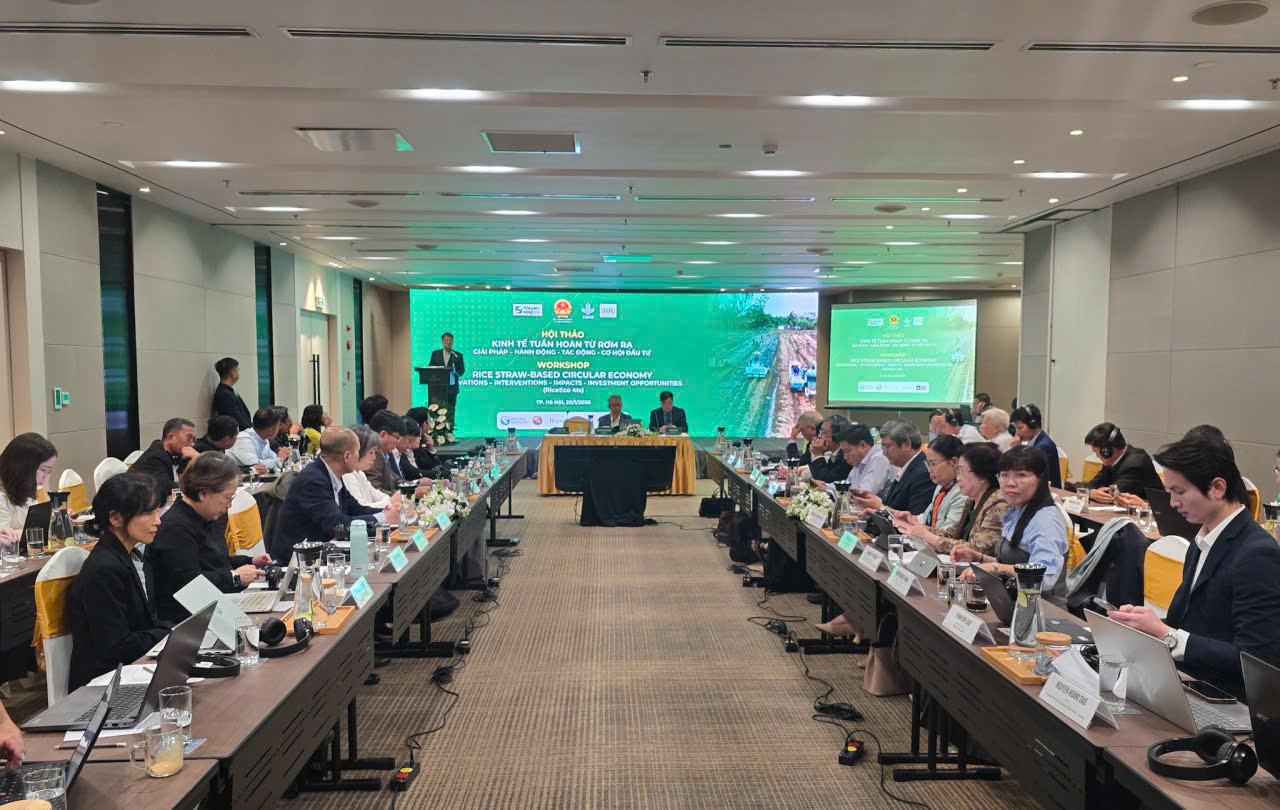
The call was made at an international workshop on the circular economy from rice straw: Innovation, Action, Impact and Investment Opportunities (RiceEco 4Is), held on Tuesday in Hà Nội. The event was co-organised by the National Agricultural Extension Centre under the Ministry of Agriculture and Environment and the International Rice Research Institute.
More than 100 policymakers, scientists, businesses, cooperatives and development partners from Việt Nam, Cambodia, Indonesia, the Philippines, and other Greater Mekong Subregion countries attended the workshop.
The discussions came amid growing pressure on countries to address environmental pollution, resource degradation and greenhouse gas reduction requirements. Rice straw, produced in vast quantities as a by-product of rice cultivation, has emerged as both an environmental burden and an economic challenge for rice-producing nations, particularly across the Greater Mekong Subregion.
Funded by the Mekong–Korea Cooperation Fund, the RiceEco project, implemented from February 2023 to January 2026, has provided scientific and practical evidence that rice straw is not waste but a valuable biomass resource within circular agriculture models.
Mapping studies and straw management strategies in the Mekong Delta show that sustainable straw management could cut emissions from rice straw by up to 36 per cent, equivalent to more than two million tonnes of CO₂e each year.
This is particularly significant as Việt Nam rolls out its programme to develop one million hectares of low-emission rice linked to green growth.
Turning straw into value
According to Nguyễn Văn Hùng, senior scientist at IRRI and Head of the RiceEco Project, after three years of implementation in Việt Nam, collecting and integrating rice straw into circular agricultural models can reduce greenhouse gas emissions by more than 30 per cent while generating over 20 per cent additional value across the rice–straw value chain.
Tiến Thuận Cooperative is a notable example of an integrated rice straw value-chain model. Compared to traditional farming, the model increases income by more than 20 per cent, equivalent to about US$640 per hectare per year. Of this, straw mushroom cultivation adds around $260 per hectare annually, while mechanised compost production combined with biological products contributes an additional $380 per hectare.
Similar results have been recorded in Cambodia, Hùng said. Cooperatives participating in RiceEco reported average profits of $136 per tonne from mechanised compost production. Wholesale compost prices range from $285–300 per tonne, while retail prices reach $320–330 per tonne. Straw mushroom cultivation generates about $256 per hectare per year, and using spent straw for compost adds a further $374 per hectare annually.
Beyond research, RiceEco has been recognised as an effective bridge between science, policy and markets through public–private partnership mechanisms. The project closely links government agencies, research institutions, financial organisations and businesses, ensuring that models are not only technically feasible but also economically sustainable and scalable.
Notably, RiceEco has directly contributed to three important national technical documents on circular, low-emission rice systems, serving the one-million-hectare high-quality, low-emission rice programme in the Mekong Delta. The project has also received several prestigious national and regional awards, including the Asia Excellence in Innovation Award 2025.
Globally, around 500–600 million tonnes of rice straw are produced each year. In the Greater Mekong Subregion, home to major rice producers such as Việt Nam, Cambodia and Thailand, this agricultural biomass accounts for a significant share.
Changing how rice straw is viewed is no longer an option. It has become a necessity, experts have said.
From environmental burden to shared benefit
Speaking at the workshop, Lê Quốc Thanh, Director of the National Agricultural Extension Centre, noted that Việt Nam produces about 44 million tonnes of rice annually, generating a vast volume of rice straw.
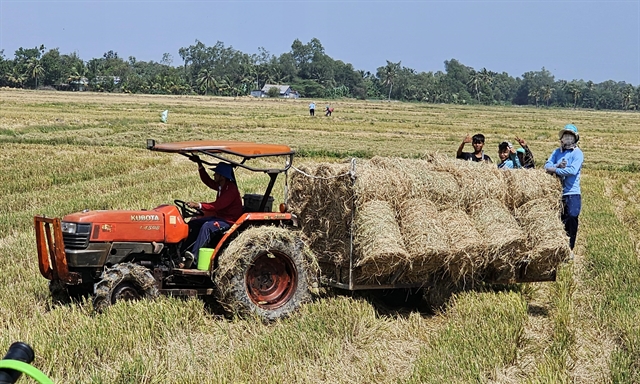
Instead of becoming an environmental burden through open-field burning, this by-product can be used as a valuable biomass resource, helping to cut greenhouse gas emissions, raise farmers’ incomes, improve soil quality and conserve biodiversity.
In practice, rice straw-based circular economy models have proven viable in many localities. Mechanised straw collection technologies, sustainable farming practices and organic fertiliser production from rice straw have been researched, tested and demonstrated as effective through cooperative projects since early 2023.
Sharing his experience, Jongsoo Shin, IRRI’s Regional Director for Asia, recalled that during a recent trip to Chiang Mai, his flight was delayed due to poor air quality and adverse weather conditions.
When rice straw is collected, reused and turned into an additional income source for farmers, Shin said, society achieves a dual impact: reducing greenhouse gas emissions, improving air quality and protecting public health, while also strengthening rural livelihoods.
Echoing this view, Suriyan Vichitlekarn, Executive Director of the Mekong Institute, emphasised that regional cooperation is crucial to scaling up successful models and building green value chains across the Greater Mekong Subregion.
According to him, RiceEco is gradually laying the foundation for a regional agricultural circular economy ecosystem aligned with the GMS Cooperation Framework 2030 and ASEAN’s post-2025 Vision.
In the Mekong Delta, where 25–28 million tonnes of rice straw are generated annually, effective management and use of this by-product are helping to cut emissions, improve production efficiency and create sustainable livelihoods.
Phan Văn Lâm, a farmer participating in the one-million-hectare low-emission rice programme and a member of Vị Thủy 1 Cooperative in Cần Thơ City, said his family cultivates one hectare of rice and has seen clear changes in farming methods after receiving technical training.
In the recent Autumn–Winter crop, new techniques helped reduce input costs while improving yield and quality, reaching about five tonnes per hectare, higher than previous seasons, he said.
As the national focal agency for agricultural extension, Thanh said the National Agricultural Extension Centre reaffirmed its commitment to continuing knowledge and technology transfer and scaling up effective models, particularly in the Mekong Delta, Việt Nam’s key rice-growing region.
From the rice fields, rice straw is gradually becoming a new resource for green growth, farmers’ livelihoods and low-emission goals in Việt Nam and across the region, he added.
Tố Như (VNS)