
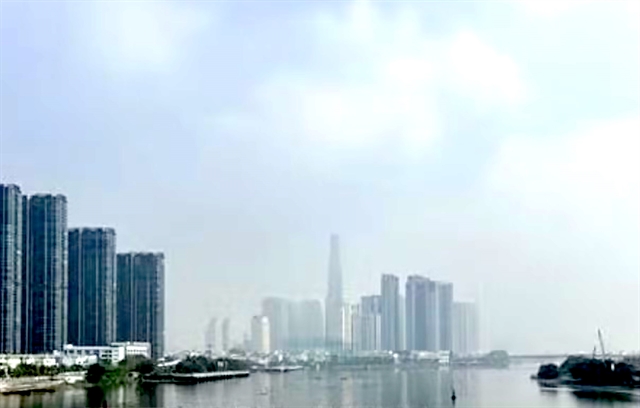
HCM City is allocating priority public funds and leveraging new legislative powers to launch a number of air quality projects for 2026-30 that will expand its smart monitoring network and combat persistent pollution.
Despite various measures, the city’s air quality has shown little improvement.
The city is introducing structural and non-structural measures to curb pollution, improve air quality, protect public health, and promote greener, more sustainable development.
These include mobilising resources from across society and expanding international cooperation on environmental protection.
Climate change and sustainable development goals have increased the need for advanced technology, better data management, and greater investment in environmental protection, particularly in continuous automated emissions monitoring.
Experts say Việt Nam’s air quality monitoring network is gradually expanding, providing essential data for environmental management.
New technologies, including digital tools and artificial intelligence, can help pinpoint pollution sources more accurately, improve forecasts, and support more targeted control measures.
However, the municipal People’s Committee acknowledges that air quality management still faces limitations.
The network of continuous automated monitoring stations remains inadequate because projects to expand monitoring capacity have encountered difficulties and delays.
The city now operates 160 air quality monitoring points and stations, including124 periodic monitoring points and 36 continuous automatic monitoring stations.
The city is investing further in monitoring infrastructure to strengthen environmental management and air pollution control alongside economic and urban development, with the goal of improving the quality of life for its people and ensuring sustainable growth.
Nguyễn Toàn Thắng, director of the Department of Agriculture and Environment, said the city People’s Committee has tasked the department with completing the continuous automated air quality monitoring network and ensuring uninterrupted data collection.
Besides, the city is investing in and also mobilising private resources to deploy rapid-response air quality sensors
It is also strengthening the integration and sharing of monitoring data with national environmental warning, forecasting, and pollution control systems.
The city is combining artificial intelligence, internet-connected sensors, and big-data modelling with emissions records to track pollution sources and issue early warnings to the public.
In line with Party Conclusion No 75-KL/TW on international integration, it is expanding cooperation with other countries to improve air quality management.
The city People’s Committee has tasked the Department of Agriculture and Environment and other agencies with strengthening research and exchanging environmental management experience with international partners.
The Department of Science and Technology has also been tasked with working with research institutes, universities, and international organisations to develop technologies for carrying out emissions inventories, monitoring air quality, and advanced exhaust treatment.
Unlocking resources through urban development legislation
Conclusion No 75-KL/TW calls for environmental and climate laws to be streamlined at once to ensure consistent regulations.
It also calls for greater decentralisation, data-driven management, inspections to ensure compliance, and controlled trials of new regulatory approaches.
Experts say the Law on Urban Development provides for greater decentralisation, allowing cities such as HCM City to overcome regulatory obstacles and mobilise more resources for socio-economic development.
Under the law, the HCM City People’s Council has expanded powers to introduce policies supporting clean-energy public transport and non-motorised transport.
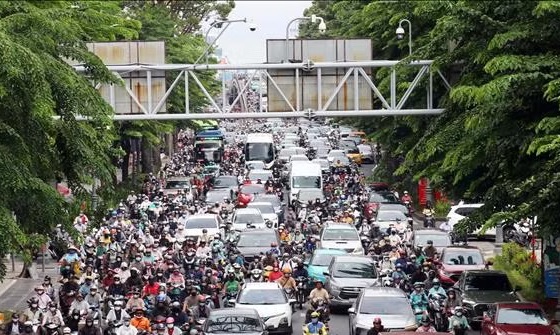
The legislation also supports the transition from fossil-fuel vehicles to cleaner alternatives, including new criteria, procedures, and restrictions aimed at reducing pollution caused by road transport.
The law allows the city to restrict private vehicles in central areas, develop green transport networks, and introduce low-emission zones in phases.
It also authorises incentives for businesses adopting circular and green economy models in transport, environmental industries, and services.
Đỗ Thiên Anh Tuấn, a senior lecturer at the Fulbright School of Public Policy and Management, said the law contains provisions for extensive decentralisation.
Article 14 gives the city additional powers over transport, low-emission zones, congestion charging, environmental protection, and solid waste management.
The legislation also allows the city to develop financial instruments to address climate and urban environmental challenges, including levies related to emissions, waste, wastewater, flood mitigation, impermeable surfaces, energy consumption, low-emission zones, and green infrastructure.
These financial measures could generate revenues for environmental projects while encouraging businesses and the public to change their behaviour and adopt greener practices.
Using these powers, the city is prioritising funding for air quality management projects in 2026–30 under the Law on Public Investment, taking account of its budget capacity.
It has identified 20 priority projects, including local initiatives and cooperation with neighbouring provinces.
They include expanding automated air quality monitoring, mapping urban emissions, controlling industrial pollution, and relocating facilities that violate urban zoning plans.
Other projects involve establishing low-emission zones, reducing vehicle emissions, improving street cleaning to limit dust from traffic and construction, and piloting financial mechanisms for green transport.
(VNS)