
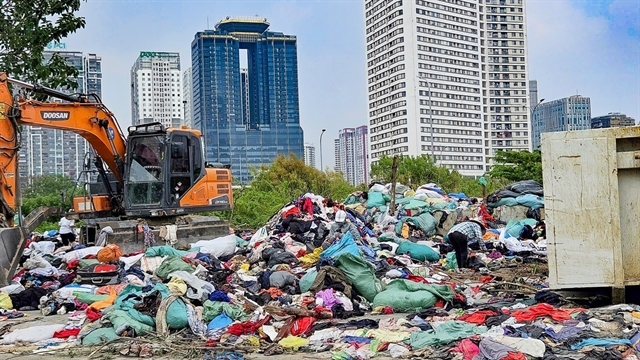
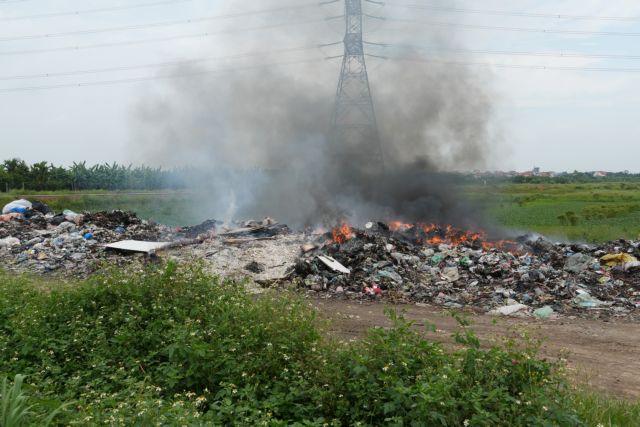
Large piles of household rubbish regularly accumulate outside the gates of Ngôi Sao School and Hoa Sữa Kindergarten in Kim Văn–Kim Lũ new urban area, Định Công Ward, Hà Nội, creating an unpleasant sight and disrupting residents’ daily lives.
The waste includes not only household refuse, but also broken furniture, damaged appliances, foam boxes, old toilets, blankets and even hazardous waste. Left scattered across the roadside, it produces foul smells and affects both traffic and public hygiene.
Nguyễn Thị Hương, who lives in the area, said residents have repeatedly reported the problem. But after the rubbish is cleared, little by little it just piles up again.
As household solid waste continues to increase, sorting rubbish at source is becoming increasingly urgent. With landfill disposal still accounting for the largest share of treatment, the country needs to move beyond simply collecting and disposing of rubbish towards recovering resources through reuse, recycling and energy generation.
This is also a key objective of the proposed amendments to the Law on Environmental Protection, which seek to strengthen waste management and promote greener recycling practices.
Growing pressure from household waste
Đỗ Tiến Đoàn, deputy head of the Waste Management Division under the Environment Department of the Ministry of Agriculture and Environment, said Việt Nam generated approximately 72,340 tonnes of household solid waste daily in 2025, with urban areas accounting for about 54 per cent and rural areas 46 per cent.
Although waste collection and treatment rates have improved considerably over the past decade, the organisation of these activities remains inadequate in many localities.
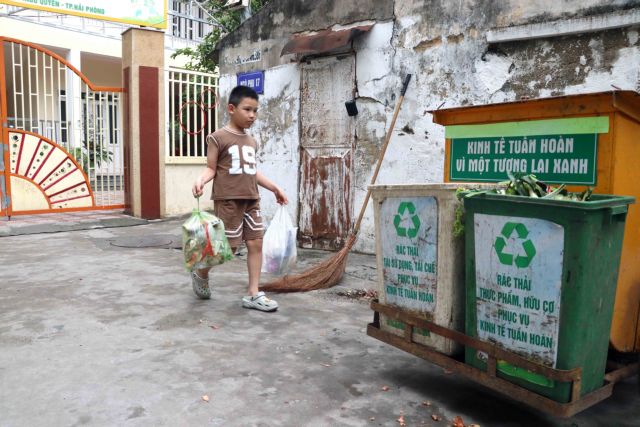
In rural areas, waste collection is often carried out periodically by community self-management groups or women’s unions. However, collection and transfer infrastructure remains insufficient in many places, creating a risk of waste accumulation and environmental pollution.
In some localities, three-wheeled vehicles and hand-pulled carts are still commonly used to collect and transport rubbish, reflecting the limitations of existing infrastructure.
Meanwhile, statistics at the end of 2025 showed that nearly 60 per cent of household solid waste was still disposed of through landfilling, while waste-to-energy incineration accounted for around 15 per cent.
The figures underline the need not only to expand collection services, but also to transform treatment methods, reduce reliance on landfills and increase recycling.
Upgrading waste treatment infrastructure
According to the Environment Department, around 37 projects are currently undergoing investment procedures, environmental impact assessment approval or construction.
Once operational, these projects are expected to enable waste-to-energy incineration to treat approximately 50 per cent of the country’s household solid waste.
Although the technology still requires strict environmental controls, particularly in the treatment of byproducts like bottom ash and fly ash, waste-to-energy incineration represents a significant improvement over conventional landfilling, especially unsanitary landfill disposal.
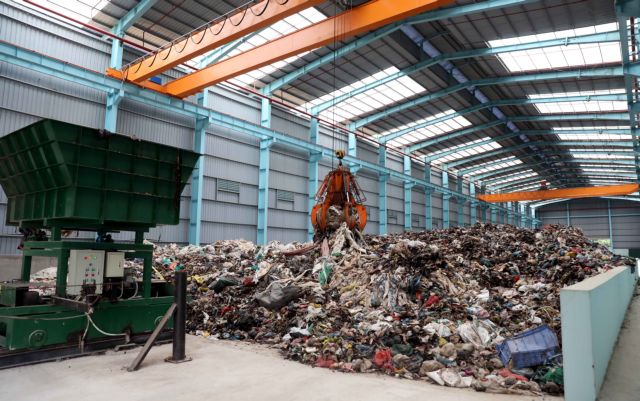
However, a major challenge remains. While many localities have introduced regulations on household waste sorting, they still struggle to organise separate collection, transportation and treatment after waste has been sorted.
Waste sorting thus cannot be reduced to asking households to put rubbish into different categories. It must be supported by an integrated system in which each type of waste is collected separately, transported appropriately and delivered to suitable recycling or treatment facilities.
Hà Nội illustrates both the progress made and the challenges ahead.
The capital generates, collects, transports and treats an average of nearly 7,800 tonnes of household solid waste every day at centralised treatment facilities. Collection coverage has reached 100 per cent in urban areas and approximately 96 per cent in rural areas.
Nevertheless, sorting waste at source remains difficult because collection infrastructure, transportation arrangements and treatment technologies are not yet sufficiently coordinated.
Nguyễn Minh Tấn, deputy director of the Hà Nội Department of Agriculture and Environment, said the city had invested in waste collection and treatment systems using both State budget funding and socialised investment.
Waste collection and transportation activities are monitored through cameras and GPS systems. The city has also digitised 1,709 waste collection and transfer points to improve supervision and management.
Hà Nội is continuing to direct communes and wards to review and allocate land for infrastructure, invest in transfer stations, waste collection points and compactor locations, and gradually modernise the system to meet waste sorting requirements.
Despite these efforts, the city still lacks sufficient capacity to treat construction waste and septic tank sludge. Legal and environmental regulations governing temporary waste reception, collection and recycling facilities also remain unclear.
Another pressing issue is the enormous volume of waste already buried at existing landfills.
The Nam Sơn waste treatment complex has accumulated approximately 30 million tonnes of buried waste, while Xuân Sơn has around 3.7 million tonnes.
Bùi Duy Cường, vice chairman of the Hà Nội People’s Committee, said the city is particularly concerned about how to deal with this legacy waste.
With waste-to-energy technology advancing and new treatment capacity being added, Hà Nội hopes to gradually process the waste already buried at its landfills.
He called on the Ministry of Agriculture and Environment and relevant agencies to provide guidance on policy orientations, implementation procedures, technical standards, regulations, unit prices and cost norms.
Deputy Minister of Agriculture and Environment Lê Trọng Yên also stressed the need for early solutions to address accumulated landfill waste. He described Hà Nội’s waste-to-energy technology as feasible and said it deserved further study.
Law aims to connect the entire waste management chain
The challenges facing Hà Nội and other localities demonstrate that household waste sorting can only work effectively when responsibilities are clearly assigned to residents, collection and transportation companies, treatment facilities and local authorities, with infrastructure and implementation mechanisms developed in parallel.
These issues also featured in discussions among National Assembly deputies on the proposed amendments to the Law on Environmental Protection.
During group discussions on October 24, several deputies called for a nationally consistent minimum standard for household waste classification, covering waste categories, technical criteria, colours, labels and specifications for bags and containers.
At the same time, local authorities should be allowed to introduce more detailed regulations suited to their conditions, they said.
Without a common framework, differences in classification systems between localities could create difficulties for waste collection and recycling companies and hinder the development of markets for secondary raw materials.
In response, the Ministry of Agriculture and Environment said it had reviewed the draft law to establish a more consistent classification framework covering three categories of household waste.
Provincial-level People’s Committees would be required to ensure that waste is classified into at least two groups, including waste suitable for reuse or recycling.
Implementation roadmaps would be determined in line with local conditions, while provincial authorities would issue detailed technical criteria and regulations on colours, labels, bags and containers.
The revised draft also prioritises reuse, recycling, co-processing and waste treatment with energy recovery.
Food waste is encouraged to be converted into animal feed, organic fertiliser or energy through biomass recovery. Other household waste should also be further sorted to recover recyclable materials for use as production inputs.
Another important concern raised by deputies is the risk of residents sorting waste at home, only for collection companies to mix it together during transportation.
In response, the ministry has added a principle requiring waste classification to be compatible with the technical infrastructure available for collection, transportation, recycling and treatment.
Provincial-level People’s Committees would also be responsible for determining implementation roadmaps suited to local conditions.
This provision is intended to address a fundamental weakness in the current system: sorting at source will have little practical value if separate waste streams are not maintained throughout subsequent stages.
The draft law also clarifies the responsibilities of different parties throughout the waste management cycle, from households and individuals to collection companies, transport operators and treatment facilities.
Collection and transportation service providers would be required to have sufficient personnel, vehicles and specialised equipment to collect and transport all waste at designated locations.
Where waste collection is refused, the process must be accompanied by guidance, publicly disclosed arrangements and compliance with relevant requirements.
The proposed legal changes will require local authorities to take a more proactive role in planning infrastructure, allocating land and mobilising investment for collection, transfer, recycling and treatment facilities.
(VNS)