
In the summer of 2026, the barges on the River Rhine had to travel half-empty as water levels on Europe’s busiest inland waterway sank to their lowest point in decades and shipping companies faced a stark choice – lighten the load or run aground.
Freight costs spiked, delivery times slipped, and economists at Germany’s Kiel Institute calculated that a single month of this kind of drought could shave a full percentage point off the country’s industrial output.
It was a small, almost mundane image – half-loaded ships crawling down a river – but it captured something larger. Climate change had stopped being a matter for environment ministries. It had become a line item in the economy.
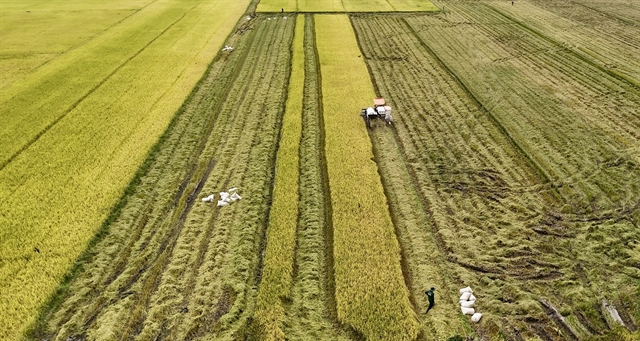
Six thousand miles away, the same arithmetic was playing out in the paddy fields of the Mekong Delta. Vietnamese meteorologists warned that the El Niño pattern building through 2026 and into 2027 could threaten some 350,000 hectares of winter-spring rice – fields that depend on a rainy season increasingly prone to ending early and letting salt water creep upstream.
Between January and the end of July, the country recorded seventeen separate types of natural disaster, including floods, landslides and saltwater intrusion.
Forty-six people died and more than 22,000 homes were damaged, 134 of them destroyed outright. Nearly 32,000ha of rice and other crops were submerged. The bill for July alone came to roughly VNĐ600 billion (US$23 million).
Numbers like these are why, on July 29, Party General Secretary and President Tô Lâm stood before a national conference and delivered a speech that officials are now calling a turning point.
Việt Nam, he said, must stop treating disasters as something to clean up after they happen. It has to shift toward actively identifying, forecasting and pre-empting climate risk – building resilience before the damage is done, not after.
The idea that climate change deserves serious political attention is not new in Việt Nam. A 2013 Party resolution – Resolution 24 – first laid out the country’s strategic thinking on the subject.
But thirteen years on, with more ambitious growth targets, tougher international climate commitments and a new generation of environmental standards baked into global trade, the Party concluded that its old framework needed an overhaul.
The result, issued on 28 July 2026, is Conclusion 75, a document that builds on Resolution 24 but pushes considerably further.
Permanent Deputy Prime Minister Phạm Gia Túc, presenting the new thinking, describing it as a change in mindset as much as policy – a shift from crisis response to development-building, from paperwork-driven administration to modern, data-based risk governance.
Party General Secretary and President Lâm made the stakes explicit in blunter terms. With provinces and cities chasing double-digit growth, he argued, disaster preparedness cannot sit on the sidelines of development; it is a precondition for it.
Climate resilience, he insisted, needs to be written directly into investment decisions, production planning and efforts to attract capital, not bolted on afterward.
“Prevention has to come first,” he told officials.
“Protecting people’s lives is the highest command. Every plan, every decision, every resource we mobilise has to be aimed, above all, at protecting our people.”
Nowhere is that instruction being tested more directly than in Đà Nẵng, the commercial hub of central Việt Nam.
With more than 200km of coastline sitting where a river system meets the open sea, the city has long taken the brunt of the country’s most extreme weather – and in recent years, officials say, storms have stopped following the old seasonal patterns, arriving instead in tighter, more violent clusters, sometimes coinciding with high tides.
Đà Nẵng’s problem is compounded by its own success. Rapid urbanisation has paved over much of the ground that once absorbed monsoon rain, and infrastructure built without a citywide view of drainage has, in places, become a barrier to water flow rather than a channel for it.
The response has been a mix of concrete and code. The city has reinforced 23.7km of seawall around Đà Nẵng Bay, along with breakwaters at Sơn Trà–Điện Ngọc, Tam Tiến, Tam Hải and a 6.4km coastal protection cluster at Hội An, while leaning on private capital for large developments such as the new Thuận Phước urban area.
More striking is what sits underneath the concrete: a network of IoT sensors feeding real-time groundwater, rainfall and flow data into the city’s intelligent operations centre, paired with an AI-driven flood map capable of predicting where deep water will pool hours before it happens.

When the system flags danger, alerts go straight to residents’ phones, traffic is automatically rerouted, and pumping stations kick in without waiting for a human to give the order.
The city is also confronting a harder question: where people should live at all?
Under a new municipal resolution passed in June 2026, Đà Nẵng has begun drafting a resettlement scheme for households in its most disaster-prone mountain areas – the legal groundwork for moving families out of landslide and flash-flood zones and into safer, more stable livelihoods.
Việt Nam is not improvising alone. Around the world, the same recalibration is under way, even if the tools differ.
Singapore, an island nation with almost no natural freshwater and constant exposure to rising seas, has spent decades building reservoirs, recycled-water systems, desalination plants and storm-integrated waterfront parks – not primarily as environmental gestures, but to protect its standing as one of Asia’s premier financial and logistics centres.
China’s meteorological agencies now work alongside power, agriculture and transport authorities to map which parts of the economy are most exposed to a stronger El Niño, pushing for expanded regional power grids and stress-tested infrastructure.
Indonesia, facing an estimated $50 billion annual price tag to reach net zero by 2060, has turned to green and blue bonds and carbon markets, treating public money as seed capital meant to pull in private investment rather than fund the transition alone.
As Kristalina Georgieva, managing director of the International Monetary Fund, has put it, climate change has become a systemic risk to the macroeconomy, with consequences for growth, investment and financial stability.
Simon Stiell, the UN’s climate chief, made a similar point at COP29. Climate finance, he argued, is not charity but a matter of national self-interest, because failure to make global supply chains climate-resilient threatens the entire world economy. Countries that act early may consequently be better placed to withstand increasingly routine disruptions.
For Việt Nam, agriculture is where this thinking has to prove itself. Drought, saltwater intrusion, flooding and erratic weather are already cutting into yields even as input costs climb and export markets tighten their demands around emissions tracking, traceability and pesticide residue.
Conclusion 75 sets a national target of building a green, circular, low-carbon economy by 2045, in step with Việt Nam’s 2050 net-zero pledge – and rice, the country’s signature crop, has become its most closely watched test case.
The scheme to convert one million hectares of Mekong Delta paddy to high-quality, low-emission rice is meant to prove that cutting emissions and raising farmers’ incomes can happen together.
Nguyễn Thị Trà My, chief executive of the PAN Group and chair of Vinaseed, argues that pulling this off requires treating rice as a full value chain, from seed breeding through cultivation, processing, branding and, increasingly, carbon credits – rather than a series of disconnected steps.
Officials see mechanisation as the next lever. Lê Viết Bình, Deputy Chief of Office of the Ministry of Agriculture and Environment, argues that Vietnamese farming needs to move beyond mechanising individual tasks toward a fully integrated model – machinery as the tool, data as the foundation, cooperatives as the organising unit, and low-emission farming as the end goal.
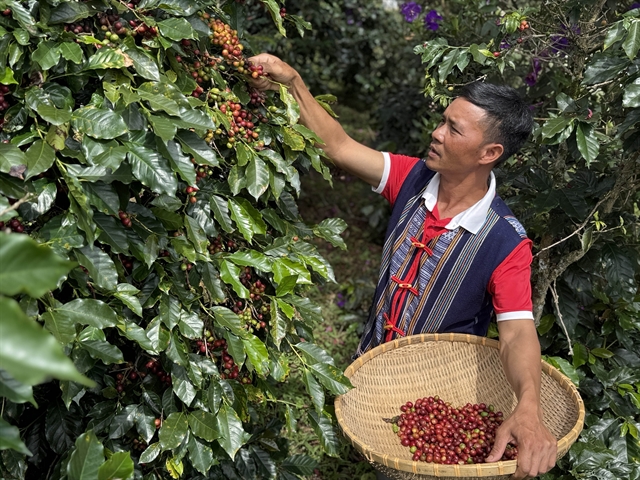
Coffee has become an early proving ground. Vĩnh Hiệp LTD CO, a major exporter with supply networks in more than sixty countries, has pushed internationally certified growing regions, circular farming practices and expanding organic acreage, framing sustainability not as compliance but as a competitive edge.
The ministry now plans to roll out low-emission labelling for staple crops – rice, coffee, fruit and vegetables – an attempt to give Vietnamese farm goods a brand: green, low-carbon, accountable.
None of this guarantees smooth passage. Rivers will keep running low somewhere, and storms will keep arriving out of season. But the wager underlying Việt Nam’s new approach – visible in Đà Nẵng’s sensor networks as much as in a Mekong Delta rice field – is that resilience, once treated as an unavoidable cost, is turning into the thing that decides who keeps growing at all.
As Deputy Minister Nguyễn Hoàng Hiệp put it, the goal is no longer simply to fight the weather. It’s to learn to live with it because when knowledge, skill and community come together, he said, they form “a steel shield sturdier than any concrete structure”.
(VNS)