
Vietnam’s energy transition is entering a new chapter. After years of focusing on expanding generation capacity to support rapid industrialization, the country’s next challenge is ensuring that an increasingly renewable-heavy electricity system can operate reliably, efficiently, and at the scale required by one of Asia’s fastest-growing economies.
That is the central message of the recent “Future Pathways for Vietnam’s Power Sector: A Scenario-Based Modelling to Support Execution of Concept to Reality” study by GE Vernova. Using production-cost modelling based on the revised National Power Development Plan VIII (PDP8), the report examined four possible pathways for Vietnam’s electricity system to 2050. Its conclusion is clear: while renewable energy will dominate future capacity additions, the success of the transition will depend equally on investments in storage, transmission, flexible generation, market reforms, and grid modernization.
The challenge reflects the pace of Vietnam’s economic growth. The country has recorded annual GDP growth of more than 6 per cent in recent years, while electricity consumption has expanded by more than 9 per cent annually; well above the global average.
With the government targeting net-zero emissions by 2050 and average GDP growth of at least 10 per cent by 2030, electricity demand is expected to continue rising rapidly, requiring a power system unlike what Vietnam has today.
Explosive demand
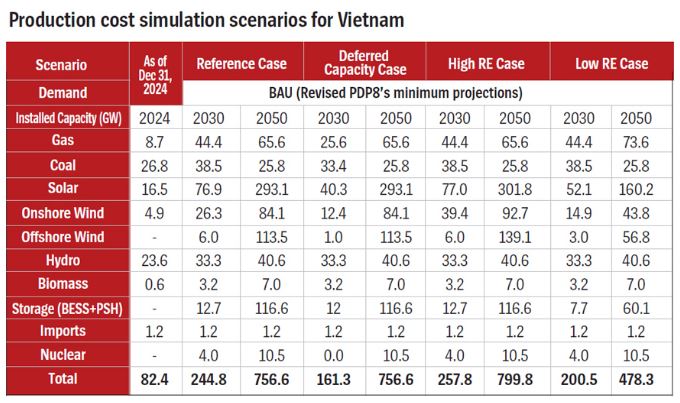
The numbers alone illustrate the scale of the transformation. Vietnam ended 2024 with 82.4 GW of installed generating capacity, including 35.4 GW of thermal power, 23.6 GW of hydropower, 21.4 GW of wind and solar, and 1.2 GW of imported electricity.
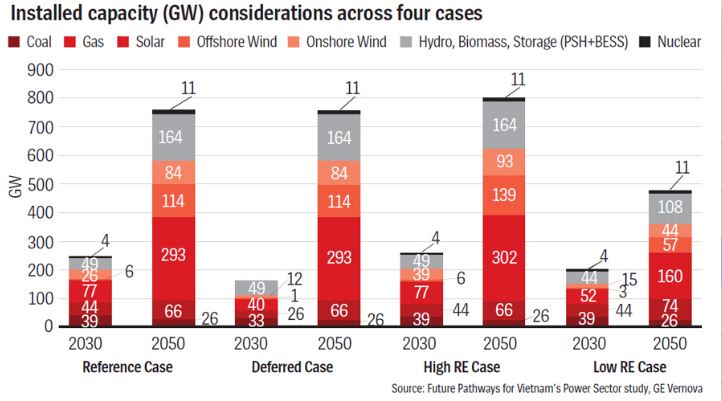
Under the Reference scenario modelled by GE Vernova, installed capacity nearly triples to 244.8 GW by 2030 before expanding to 756.6 GW by 2050. Peak electricity demand is projected to rise from 49 GW today to 89.7 GW by 2030 and 205.7 GW by mid-century, while annual electricity consumption will increase from 275 TWh to 500 TWh and eventually 1,238 TWh.
The report attributes this growth primarily to continued industrialization, urbanization, and export manufacturing, while highlighting new sources of demand that are expected to become increasingly important over time. By 2050, electric vehicles could account for around 13 per cent of annual electricity demand and about 4 per cent of peak load, while data centers contribute roughly 3.6 per cent of electricity consumption and 2.5 per cent of peak demand.
To understand how Vietnam’s power system could evolve under different circumstances, the study modeled four scenarios. The Reference case follows the minimum targets in the revised PDP8, while the Deferred Capacity case assumes generation projects continue to be completed at today’s slower pace. A High Renewable scenario adopts the plan’s maximum renewable targets, whereas a Low Renewable scenario assumes only around half of planned wind and solar additions are realized. Rather than predicting which path Vietnam will follow, the scenarios are designed to identify potential operational challenges and stress points under different development trajectories.
Across all four pathways, the direction of travel remains the same. Renewable energy steadily becomes the dominant source of installed capacity, while operating the electricity system grows significantly more complex.
Making renewables work
The revised PDP8 envisages one of the most rapid renewable energy expansions in the region. Under the Reference scenario, solar capacity rises from 16.5 GW today to 76.9 GW by 2030 and 293.1 GW by 2050. Onshore wind increases from 4.9 GW to 26.3 GW by 2030 before reaching 84.1 GW by mid-century, while offshore wind expands from virtually zero today to 6 GW in 2030 and 113.5 GW by 2050. Together with hydropower and biomass, renewable technologies will account for roughly 70 per cent of installed capacity by mid-century.
Yet one of the study’s most notable findings is that installing more renewable capacity does not automatically translate into proportionally higher renewable generation. In the High Renewable scenario, wind and solar capacity is about 12 per cent higher than in the Reference case by 2050, but renewable generation increases only marginally because the system increasingly struggles to absorb surplus electricity during periods of high renewable output.
This challenge becomes evident in renewable curtailment. Under the Reference scenario, combined wind and solar curtailment rises from 7.4 per cent in 2030 to 24 per cent by 2040 before remaining above 23 per cent in 2050. In the High Renewable scenario, curtailment reaches nearly 31 per cent in 2040. Conversely, the Deferred Capacity scenario records much lower curtailment in the early years because renewable deployment proceeds more gradually, although those levels increase as capacity catches up later in the transition.
The modelling suggests the solution is not to slow renewable deployment but to accelerate investments that make those resources usable. Battery energy storage systems and pumped-storage hydropower expand from almost zero today to 12.7 GW by 2030 and 116.6 GW by 2050 under the Reference case.
The report also highlights demand-side flexibility, coordinated electric vehicle charging, hydrogen production through Power-to-X technologies, and stronger regional interconnections as ways to reduce renewable curtailment. When surplus renewable electricity is diverted to hydrogen production, for example, curtailment in the Reference scenario falls from 7.4 per cent to just 2 per cent in 2030 and remains below 12 per cent throughout the modelling period.
Flexible thermal generation also remains an essential part of the transition. Gas-fired capacity increases from 8.7 GW in 2024 to 44.4 GW by 2030 before reaching 65.6 GW by 2050, providing the rapid-response capability needed to balance variable renewable output.
Coal capacity rises from 26.8 GW to 38.5 GW by 2030 as projects already under construction are completed, but no additional coal plants are added thereafter. Instead, existing facilities are expected to transition progressively to biomass or ammonia, while gas plants are envisioned to evolve toward hydrogen and carbon capture technologies over the longer term.
The report also found that delaying planned projects carries significant consequences. In the Deferred Capacity scenario, greater reliance on existing thermal plants leads to higher wholesale electricity prices and slower emissions reductions during the early years of the transition, reinforcing the importance of timely project delivery.
Behind the transition
The report argues that Vietnam’s biggest energy project over the next two decades may not be building renewable generation itself, but building the electricity system capable of supporting it. Renewable resources are unevenly distributed across the country. Hydropower is concentrated largely in the north and central regions, while solar resources are strongest in central and southern Vietnam.
Meanwhile, roughly 91 per cent of electricity demand is concentrated in the north and south, making transmission infrastructure increasingly critical. Central Vietnam is expected to play an even greater role as the country’s primary transmission corridor, moving electricity between generation centers and major load hubs.
To support that shift, inter-regional transmission capacity must expand substantially. North-to-central transfer capability increases from 4,000 MW in 2024 to 26,800 MW by 2050, while south-to-central transmission grows from 12,400 MW to 29,200 MW over the same period.
Alongside investments in high-voltage transmission, the study identifies smart-grid technologies, advanced forecasting systems, and real-time grid management as increasingly important for maintaining system stability as renewable penetration continues to rise.
The transformation extends well beyond physical infrastructure. The report estimates that Vietnam’s power sector workforce will expand from around 300,000 people today to approximately 500,000 by 2035, with wind and solar accounting for more than half of direct employment. It also recommended broadening financing sources through export credit agencies, commercial lenders, and bankable project structures to help mobilize the capital needed across generation, storage, transmission, and digital technologies.
The revised PDP8 provides the roadmap for Vietnam’s electricity future. GE Vernova’s said realizing ambitions will require treating system flexibility with the same priority as renewable deployment, ensuring that the country’s clean energy capacity can reliably power continued economic growth through 2050.
Diep Linh